
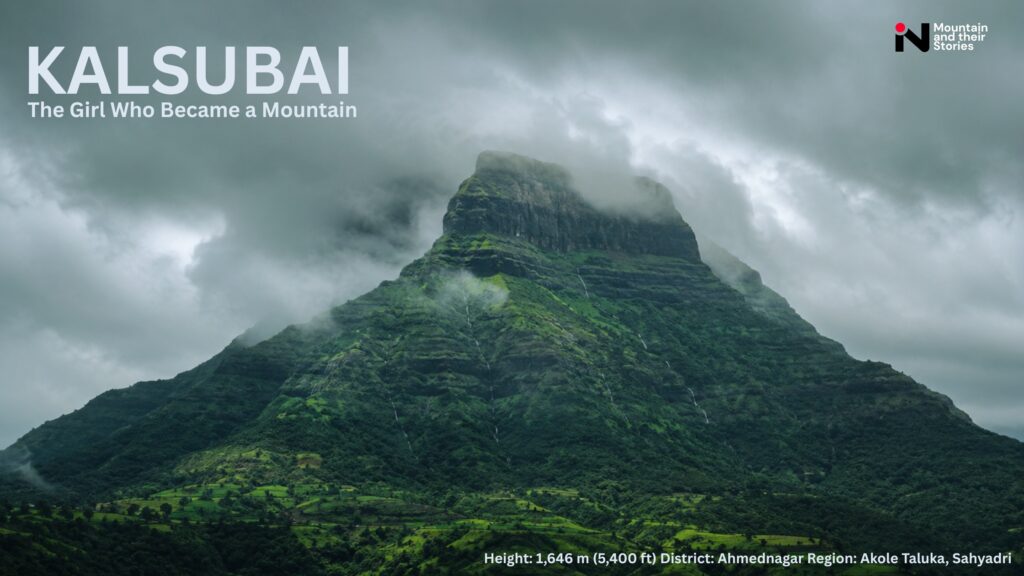
Height: 1,646 m (5,400 ft) District: Ahmednagar Region: Akole Taluka, Sahyadri
About The Mountain
There is a mountain in the Sahyadri range that stands taller than every other peak in Maharashtra. It does not announce itself with noise or drama. It simply rises, steady, patient, unhurried, until it is above everything around it.
This is Kalsubai. At 1,646 metres above sea level, it is the highest point in the state. People call it the Everest of Maharashtra. That is a big name for a mountain that, from a distance, looks almost gentle. Its slopes are green in the monsoon, brown and golden in winter. The ridgeline runs long and unbroken, and from the plains of Ahmednagar far below, it sits against the sky like something permanent. Like it has always been there and always will be.
The mountain lies in Akole Taluka, in the Ahmednagar district, tucked inside the Kalsubai-Harishchandragad Wildlife Sanctuary, a protected forest that stretches for over 360 square kilometres. Leopards live here. The shaggy Indian giant squirrel moves through the upper canopy. In the monsoon months, when the entire Sahyadri turns a deep, breathing green, Kalsubai disappears into cloud and mist and becomes something you can only feel, not see.
The base village for most people who come here is Bari, a small farming settlement about six kilometres from Bhandardara. The path begins gently enough, through fields and open land. Then it climbs. The upper sections are steep, and iron ladders have been fixed into the rock face at the most difficult points. These ladders were put there by locals over the years, one practical gift from the people who live at the foot of this mountain to the people who come to climb it.
At the very top, on a small flat area of land where the summit levels off just enough, there is a temple. It is not a grand structure. It is modest, wind-battered, and deeply cared for. A priest comes to perform prayers every Tuesday and Thursday. During Navratri, the festival of the goddess, thousands of pilgrims and trekkers make their way up through the night to be at the top for sunrise. The mountain that morning becomes a river of moving torches and quiet prayers.
From the summit, on a clear day, you can see Alang, Madan, Kulang, Harishchandragad, and Ratangad, an entire world of mountains laid out below you. It is the kind of view that makes you understand, for a moment, why people have always felt that the top of a mountain is closer to something true.
— — —
The Name
Most mountains in the Sahyadri are named after the forts built on them, or the rivers born near them, or the gods people placed there. Kalsubai is different. It is named after a person. A woman. And not a queen or a goddess or a figure from sacred scripture, but an ordinary young woman from a small village who, according to the people of this region, lived, worked, and one day walked up this mountain and did not come back.
The name Kalsubai comes from Kalsu, a short, everyday name, the kind a family would use at home. Bai is a common suffix in Marathi, used respectfully for women. So Kalsubai simply means: the woman Kalsu. Nothing royal about it. Nothing distant. Just a name, given to the tallest mountain in Maharashtra, after a girl from the community that lived at its feet.
It is also believed, according to local tradition, that Kalsubai was one of three sisters, Kalsubai, Ratnabai, and Katrabai. The nearby peak called Ratangad, which stands proud to the south and is sometimes called the Jewel of the Sahyadris, is said to be named after the second sister, Ratnabai. Three sisters, three mountains. The Sahyadri, it seems, kept them together even after they were gone.
— — —
The Stories
Ask ten people in the villages around this mountain who Kalsubai was, and you may hear ten versions of her story. That is not a problem. That is how folk stories work. They live in the mouths of people, and mouths shape things differently over time and distance. What stays the same across all the versions is this: a woman named Kalsu came to this place, and this place remembered her.
Here are the stories as they are told.
The Maidservant Who Would Not Be Broken
The version most often told around Bari and the nearby villages of Akole Taluka goes like this. Kalsu was a young woman from the Koli Mahadev community, one of the tribal communities that have lived in these hills for centuries. She came to work as a domestic helper in the house of a Patil family in the village of Indore, at the foot of the mountain.
Before she agreed to work, she set one condition. She told them clearly: she would do most work, but she would not clean dirty utensils and she would not sweep garbage. The Patil family agreed.
For a time, things went well. Then one day, when guests arrived and there was extra work to be done, the family asked Kalsu to wash the utensils. She did it. She kept her word, did the work as asked. But when it was over, she left. She walked out of that house, crossed the village, and began walking toward the mountain. She climbed and climbed, and when she reached the top, she stayed. She never came back down.
Locals say she did not die on that mountain. She simply chose it. She made the peak her home and lived there until the end of her days. After she passed, the villagers built a small temple on the summit in her memory. Over time, people began to come not just to remember her, but to seek her blessings. The woman became a devi, a goddess. The mountain took her name.
The Healer Who Climbed and Was Not Seen Again
Another version, told by some of the older people of the region, describes Kalsubai as a young woman known for her ability to heal. It is said she could cure sickness in the village, in both people and animals. She was gentle and kind, and people trusted her.
One day, she climbed to the top of the mountain. No one knows exactly why. Perhaps she went to gather herbs. Perhaps she simply went to be alone. But she did not return. The villagers searched. They found nothing. It is said she disappeared near the summit, as if the mountain had taken her in.
The people of the village built a temple where she was last seen. They continued to come to her, even though she was no longer there in body. They believed she was still listening. The temple on the peak of Kalsubai, tended to this day, is said to be that very place of remembrance.
The Daughter-in-Law Who Found Her Freedom
A third version, recorded by some who have spoken to residents near Bhandardara, says that Kalsubai was a daughter-in-law, a young bride who had come to her husband’s family and found life there unbearable. Her in-laws tormented her, it is said. One day, she could take it no more. She ran. She ran toward the mountain and kept running, kept climbing, until she reached the very top. And there, the torment could not follow her.
In this telling, the mountain is a place of escape and, finally, of peace. The temple at the top is a place where women have long come to pray, and it is not hard to understand why, when you know this version of the story.
Three stories. One woman. All of them point to the same truth: Kalsu was someone ordinary people remembered fiercely enough to name a mountain after her. She was not a warrior. She was not a ruler. She had no army, no kingdom, no recorded history. She was a young woman from a hill community, and she mattered so much to the people around her that when she was gone, they put her name on the highest peak in Maharashtra and kept coming back to tell her things.
There is something worth sitting with in that.
— — —
Why It Still Matters
Every year, during the nine nights of Navratri, something remarkable happens on this mountain. Pilgrims begin climbing in the dark, some as early as midnight, so that they can stand at the summit temple when the sun comes up. They come from the villages of Ahmednagar and Nashik, from Pune and Mumbai, from places hours away. They walk up in the cold and the dark, carrying flowers and diyas and prayers, and when the light comes, they offer all of it to Kalsubai Devi.
Right beside them, with headlamps and trekking poles, are the young people who come for the night trek, for the experience, the stars, the sunrise. Trekker and devotee, side by side, on the same path to the same peak. They are not there for the same reason. But in some way, they are.
Kalsubai has been the highest point in Maharashtra for as long as there has been a Maharashtra. The Koli Mahadev community has lived at its feet for generations. The mountain has been a sanctuary, officially, since 1986, when the government declared it a wildlife sanctuary, and unofficially, for centuries before that. It is a place where leopards and trekkers and pilgrims share the same terrain, each keeping a respectful distance from the others.
The temple at the top is small. The mountain is large. And somewhere in that contrast, the small human thing placed carefully on the highest natural point, is the whole story of the Sahyadri. People look up at these mountains and they feel something. They build something. They give it a name. And then, for hundreds of years, they keep coming back.
Kalsubai has been waiting, at 1,646 metres, for all of them.
— — —